Today I finally fitted up the new anchor and chain.
Anchors are another hotly debated subject in the boating world and raise heckles and opinions all around.
I opted for a Plastimo Kobra 2 anchor, the boat came originally with a Bruce claw type anchor, no doubt a clone of some sort, the claws are good in some aspects in that they are easy to set, but do drag easily, they came from oil platforms originally and work well in a massive scale, but scaled down they are not so great.
With anchors there is a huge selection, some better than others for different types of bottoms, but unless you have deep pockets and lots of storage most boaters are limited to two, one,main and one kedge (a smaller anchor normally used off the stern.
The Kobra 2 anchor did very well in most tests and feedback from owners has been very positive and lastly price wise here in the UK it is much cheaper than other brands that many cruisers use, eg fortress or Manson supreme etc
The chain went on with a few hitches, the windlass packed in half way through (would only wind one way) a few knocks to the solenoid got the motor going again, (it must have dodgy contacts), heaving 80m of chain by hand is not the best of fun.
80m of chain is a good number, keeps the weight down a bit, but allows for plenty of chain for deeper anchorages , most cruising boats are sold with anywhere from 30-50m of chain out of the box so to speak, while fine for most everyday cruising, there are many times where you would want more!
Just watch that the chain you select matches the gypsy in the windlass, or you are in for one headache!
I used a Kong swivel to connect the anchor and chain, these are among the better swivels, many don't use swivels as the are a weak point, but they do make retrieving the anchor so much easier and some bow rollers don't get on too well with bow shackles ( a rounded shackle which connects the chain to anchor)
Showing posts with label boats. Show all posts
Showing posts with label boats. Show all posts
Friday, 16 March 2012

Saturday, 28 January 2012
Inverters
My one main concession to the civilised world was ice. I really did not want to spend several years with warm beverages. Now the boat does have a large fridge with a small compartment which can make ice, but does so in small quantities and very slowly.
I bought a small desktop ice maker, about the size of a breadmaker or small microwave oven, in the paperwork it claims to consume only 140watts of power, on the land this would be nothing, but as per usual on a boat everything is difficult.
I already had a 300 watt pure sine wave inverter from my old boat, an inverter turns the 12v dc from a boats batteries into 240v ac just like what comes out of a socket in a house. The inverter claims 600w surge capability, so I hoped this would power the 140w ice maker. Not a chance! plugged it in and red lights lit up when the compressor in the icemaker tried to start up.
The problem with things electronic that have motors in them , is their start up surge ,which may be several times the devices normal power use. The general rule of thumb is about 3 x the devices rated power will normally get them started. Well this rule of thumb did not prove right for me. Trying to be a cheapskate and save money I ordered a 500w pure sine wave inverter which had a 1000w surge rating, plug in the ice maker, red lights again, it cuts out.
So I did a little research ,only to find out that icemakers consume 2100w on start up, granted only for a small amount of time,but long enough that the surge capabilities of most inverters can't keep up with it. I ended up having to get a 2500w inverter just to run a 140w appliance.. ....Who'd have guessed! (I should have, I've got a degree in electrical engineering, homer simpsom dooh moment)
So if any of you out there are considering running things on inverters, which have motors in them, be aware you'll need a far larger inverter than you think, don't buy a small one and waste your money!
I would also recommend sticking with pure sine wave units, the modified sine wave inverters (ie square wave) can play havoc with many electronic items, they are a little cheaper, but this is one case where cheapness could cost you big time later down the road when it destroys the things you plug into it.
I bought a small desktop ice maker, about the size of a breadmaker or small microwave oven, in the paperwork it claims to consume only 140watts of power, on the land this would be nothing, but as per usual on a boat everything is difficult.
I already had a 300 watt pure sine wave inverter from my old boat, an inverter turns the 12v dc from a boats batteries into 240v ac just like what comes out of a socket in a house. The inverter claims 600w surge capability, so I hoped this would power the 140w ice maker. Not a chance! plugged it in and red lights lit up when the compressor in the icemaker tried to start up.
The problem with things electronic that have motors in them , is their start up surge ,which may be several times the devices normal power use. The general rule of thumb is about 3 x the devices rated power will normally get them started. Well this rule of thumb did not prove right for me. Trying to be a cheapskate and save money I ordered a 500w pure sine wave inverter which had a 1000w surge rating, plug in the ice maker, red lights again, it cuts out.
So I did a little research ,only to find out that icemakers consume 2100w on start up, granted only for a small amount of time,but long enough that the surge capabilities of most inverters can't keep up with it. I ended up having to get a 2500w inverter just to run a 140w appliance.. ....Who'd have guessed! (I should have, I've got a degree in electrical engineering, homer simpsom dooh moment)
So if any of you out there are considering running things on inverters, which have motors in them, be aware you'll need a far larger inverter than you think, don't buy a small one and waste your money!
I would also recommend sticking with pure sine wave units, the modified sine wave inverters (ie square wave) can play havoc with many electronic items, they are a little cheaper, but this is one case where cheapness could cost you big time later down the road when it destroys the things you plug into it.
 | |
| Notice the 500w is exact same as the 300w mmm |
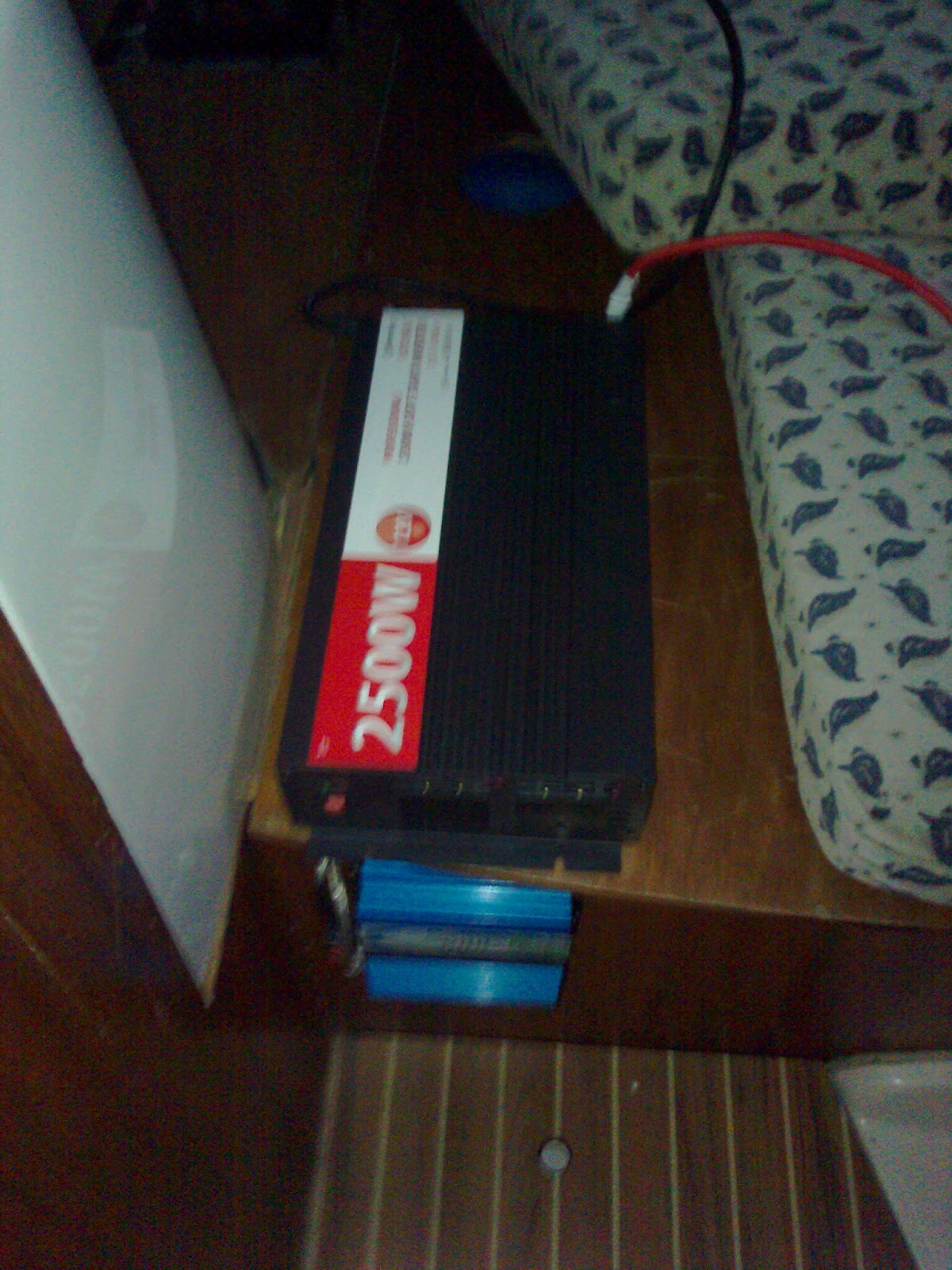 |
| Testing the 2500w only to run a 14ow load, crazy! |
Subscribe to:
Posts (Atom)